AI Character Consistency in Video: The Complete Guide
By Camilo Villa, Founder, Artiroom. Published 2026-03-24. 11 min read.
A deep technical guide to understanding and solving character consistency in AI video generation, covering identity drift, current approaches, and why Visual DNA represents a fundamentally different solution.
AI Character Consistency in Video: The Complete Guide
Character consistency is the single biggest unsolved problem in AI video generation. You can generate a stunning 4-second clip of a character, but the moment you generate a second clip, that character looks like a different person. Different jawline, different eye spacing, different hair color, different clothing details. For any storytelling application - short films, series, brand content, animations - this makes most AI video tools functionally unusable.
This guide explains why character consistency is hard, what the current approaches are, why most of them fail, and how Visual DNA offers a fundamentally different architecture.
In this guide:
- [What Is Character Consistency?](what-is-character-consistency)
- [Why Character Consistency Is Hard](why-character-consistency-is-hard)
- [Current Approaches (and Why They Fall Short)](current-approaches-and-why-they-fall-short)
- [The Character Consistency Benchmark](the-character-consistency-benchmark-where-tools-stand)
- [How Visual DNA Is Different](how-visual-dna-is-different)
- [Practical Implications](practical-implications)
- [The Future of Character Consistency](the-future-of-character-consistency)
- [The Bottom Line](the-bottom-line)
---
What Is Character Consistency?
> Key takeaway: Character consistency means a character looks identifiably like the same individual across every scene - preserving facial identity, body proportions, clothing, and distinguishing features regardless of angle or lighting.
Character consistency means a character looks identifiably like the same individual across multiple generated scenes, camera angles, lighting conditions, and poses. In traditional animation or live-action film, this is trivially achieved - you draw the same character model or film the same actor. In AI video generation, it is extremely difficult because of how diffusion models work.
A consistent character must preserve:
- Facial identity - eye shape, nose structure, jawline, skin tone, facial hair
- Body proportions - height, build, limb ratios
- Clothing and accessories - exact garments, colors, patterns, jewelry
- Distinguishing features - scars, tattoos, unique hairstyles
- Style coherence - the character should feel like it belongs in the same visual universe across scenes


---
Why Character Consistency Is Hard
> Key takeaway: Diffusion models have no concept of individual identity in their latent space - each generation samples a different point, producing a different person even from the same prompt.
The Latent Space Problem
Diffusion models generate images and video by iteratively denoising samples from a latent space - a high-dimensional mathematical representation of visual concepts. When you prompt "a woman with red hair in a blue jacket," the model samples from the region of latent space that matches that description. But that region contains millions of possible women with red hair in blue jackets. Each generation samples a different point, producing a different individual.
There is no "identity coordinate" in latent space. The concept of "this specific person" doesn't exist as a dimension the model can lock onto.
Identity Drift
Even when using techniques to anchor a character's appearance, identity drift occurs over sequential generations. Small variations accumulate: the nose gets slightly wider, the eyes shift from green to hazel, the jacket changes shade. By scene 5 or 6, the character is noticeably different from scene 1, even if each adjacent pair of scenes looks "close enough."
This is analogous to the game of telephone - small transmission errors compound into large deviations.
The Multi-View Problem
A character needs to look consistent from the front, side, three-quarter view, from above, and from behind. Diffusion models learn these views independently from training data, and the mapping between views for a specific character identity is not explicitly learned. A model can generate a convincing front view and a convincing side view, but they will rarely look like the same person.
Lighting and Environment Interaction
Characters interact with their environments through lighting, shadows, and reflections. A character in a sunlit park should look like the same person in a dimly lit room - just with different lighting. Most models regenerate the character for each environment, losing identity in the process.
---
Current Approaches (and Why They Fall Short)
> Key takeaway: LoRA, IP-Adapter, reference images, and seed locking each address symptoms of identity drift but none solve the underlying architectural gap in how diffusion models represent identity.
LoRA Fine-Tuning
What it is: LoRA (Low-Rank Adaptation) fine-tunes a small subset of model weights on a set of reference images of a specific character. This "teaches" the model what the character looks like.
How it works: You provide 10-30 images of the character from different angles and expressions. The LoRA training process adjusts specific weight matrices so the model learns to generate that character when triggered by a specific token.
Why it falls short:
- Requires significant training time (30 minutes to several hours)
- Overfitting causes the character to appear in the same pose and expression repeatedly
- Underfitting produces a character that only vaguely resembles the reference
- Every new character requires a separate LoRA training run
- LoRAs are model-specific - they break when the base model updates
- Not practical for rapid iteration or real-time creative workflows
Reference Images / Image-to-Video
What it is: Providing a reference image of the character alongside the text prompt, expecting the model to maintain that appearance.
How it works: The reference image is encoded and injected into the generation pipeline as conditioning information, theoretically guiding the output toward matching the reference.
Why it falls short:
- Models treat the reference as a "suggestion" rather than a strict constraint
- Pose changes cause the model to deviate significantly from the reference
- Only the most prominent features are preserved; subtle details drift
- No mechanism for preserving identity across multiple scenes - each generation uses the reference independently
IP-Adapter and Face Embeddings
What it is: IP-Adapter extracts image embeddings from a reference and injects them into the cross-attention layers of the diffusion model. Face-specific variants (e.g., IP-Adapter-FaceID) use facial recognition embeddings.
How it works: A CLIP or face recognition model creates a numerical representation of the reference face. This embedding is injected into the generation process to guide the output toward matching facial features.
Why it falls short:
- Preserves general facial structure but loses fine details
- Struggles with non-frontal angles
- Clothing, accessories, and body proportions are not captured by face embeddings
- The "style" of the embedding often bleeds into the scene, making all characters look similar
- Quality degrades significantly with stylized or animated characters
Seed Locking and Prompt Engineering
What it is: Using the same random seed and detailed prompts to try to reproduce the same character.
Why it falls short:
- Extremely fragile - changing any word in the prompt shifts the output dramatically
- Cannot handle different poses, angles, or environments
- Not a real solution, more of a workaround that occasionally produces acceptable results
[See how these tools compare side by side in our full comparison](/blog/best-ai-short-film-generators-2026)

---
The Character Consistency Benchmark: Where Tools Stand
> Key takeaway: The gap is architectural, not incremental - Pika and Sora expose no cross-generation identity mechanism at all, and Runway's reference image has to be re-supplied and re-matched on every generation.
Independent benchmarks have quantified the consistency problem:
- Pika scored 1.4 out of 10 on cross-scene character identity preservation in a 2025 benchmark study, meaning characters were nearly unrecognizable between scenes.
- Runway holds a 2.5 out of 5 average on Trustpilot, with character inconsistency cited as one of the most frequent complaints from paying subscribers.
- Sora produces impressive individual clips but provides no mechanism for cross-generation identity, scoring effectively 0 on multi-scene consistency without manual intervention.
These scores reflect the fundamental limitation: these tools were built for single-clip generation and have not solved the multi-scene identity problem.
---
How Visual DNA Is Different
> Key takeaway: Visual DNA treats character identity as an architectural principle - analyzing 40+ visual attributes independently and applying them as generation constraints, not suggestions.
Visual DNA, developed by Artiroom, takes a fundamentally different approach. Rather than trying to bolt consistency onto an existing frame-by-frame generation pipeline, Visual DNA treats character identity as an architectural principle.
What Visual DNA Analyzes
When you create a character in Artiroom, the Visual DNA system extracts and catalogs 40+ visual attributes:
- Facial geometry - eye spacing, nose bridge angle, jawline curvature, cheekbone prominence, lip shape
- Coloring - exact skin tone values, hair color and highlights, eye color, eyebrow color
- Body proportions - shoulder width relative to height, limb ratios, build classification
- Clothing specifics - fabric type, color values, pattern geometry, fit characteristics
- Texture and material - skin texture, hair texture (curly, straight, wavy), fabric weave
- Distinguishing features - scars, tattoos, birthmarks, jewelry, piercings, glasses
- Lighting response - how the character's materials respond to different lighting conditions
How It Preserves Identity
Unlike reference image approaches that provide a single conditioning signal, Visual DNA creates a multi-dimensional identity profile that constrains the generation across all relevant attribute dimensions simultaneously. Each scene generation is conditioned not just on "what the character looks like" but on the complete set of physical characteristics that define the character.
This means:
- The character maintains identity across different camera angles because the 3D structural attributes (proportions, geometry) are preserved independently of view angle.
- The character looks correct in different lighting because material and color attributes include lighting response characteristics.
- Clothing stays consistent because fabric, color, and fit are tracked as independent attributes rather than being lumped into a general "appearance" embedding.
- Fine details persist because distinguishing features are explicitly cataloged rather than left to a lossy embedding to capture.
[Learn everything about how Visual DNA works](/blog/what-is-visual-dna-ai-video)
Visual DNA vs. Other Approaches
| Approach | Training Required | Fine Detail | Multi-Angle | Speed | Clothing |
|----------|------------------|-------------|-------------|-------|----------|
| LoRA | 30+ min per character | Medium | Poor | Slow | Poor |
| IP-Adapter | None | Low | Poor | Fast | None |
| Reference Image | None | Low-Medium | Poor | Fast | Minimal |
| Visual DNA | None | High | Strong | Fast | Full |
---
Practical Implications
> Key takeaway: Character consistency transforms AI video from a clip-generation novelty into a genuine filmmaking, branding, and series production tool.
For Short Film Creators
Character consistency transforms AI video from a clip-generation toy into a filmmaking tool. With Visual DNA, you can plan a 20-scene short film knowing that your protagonist will look like the same person from the opening shot to the final frame.
For Brand Content
Brand mascots and spokescharacters require absolute consistency. A cartoon brand ambassador that changes face between Instagram posts destroys brand recognition. Visual DNA enables serialized brand content with reliable character identity.
For Animation
Animated characters require even more precise consistency than photorealistic ones, because viewers are highly sensitive to style changes in stylized content. Visual DNA's attribute-level tracking handles stylized characters as effectively as photorealistic ones.
For Series and Episodic Content
The rise of AI-generated series on YouTube and social platforms demands characters that audiences can follow across episodes. Without consistency, there is no audience attachment, and without attachment, there is no viewership growth.
[Follow our step-by-step tutorial to make your first consistent AI short film](/blog/how-to-create-ai-short-film)
---
The Future of Character Consistency
> Key takeaway: Character consistency will be the primary differentiator in AI video for the next 2-3 years as single-clip quality converges across providers.
Character consistency will be the primary differentiator in AI video for the next two to three years. As single-clip quality converges across providers, the ability to tell coherent multi-scene stories will separate production-ready tools from toys.
Expect to see every major AI video platform announce some form of character consistency feature by late 2026. The question is whether they'll solve it at the architectural level - as Visual DNA does - or bolt on partial solutions that inherit the limitations of their existing pipelines.
For creators working today, the choice is clear: if your work requires characters that look the same across scenes, you need a tool that was built for that purpose from the ground up.
---
The Bottom Line
> Summary: Character consistency is the defining challenge in AI video generation - diffusion models lack a native concept of identity, causing characters to change between scenes. Artiroom's Visual DNA solves this architecturally by tracking 40+ visual attributes as independent generation constraints, reused across every scene rather than re-supplied per generation.
Frequently Asked Questions
What is character consistency in AI video?
Character consistency means an AI-generated character maintains the same facial features, body proportions, clothing, and distinguishing details across multiple scenes and camera angles. It is the biggest unsolved challenge in AI filmmaking because diffusion models generate each clip independently.
Why do AI characters look different in each scene?
Diffusion models sample from a latent space where the concept of individual identity doesn't exist as a fixed coordinate. Each generation produces a slightly different version of the character, and these variations compound across scenes - a phenomenon called identity drift.
What is identity drift in AI video generation?
Identity drift occurs when small variations in character appearance accumulate across sequential AI-generated scenes. Like a game of telephone, each scene deviates slightly from the last, until the character in scene 10 is unrecognizable from scene 1.
Does LoRA training solve character consistency?
LoRA helps but doesn't fully solve character consistency. It requires 30+ minutes of training per character, often overfits to specific poses, breaks when the base model updates, and still struggles with different angles and lighting conditions.
How does Visual DNA maintain character identity?
Visual DNA analyzes 40+ visual attributes - facial geometry, coloring, proportions, clothing, textures, and distinguishing features - and preserves them as architectural constraints during generation. Unlike single-embedding approaches, it tracks each attribute dimension independently.
Which AI video tool has the best character consistency?
Artiroom is built around cross-scene identity preservation: it extracts a 40+ attribute Visual DNA profile once and applies it as a constraint on every subsequent generation. Pika and Sora provide no persistent identity mechanism, and Runway requires a reference image to be re-supplied and re-matched on each generation.
character consistencyVisual DNAAI video
AI Character Consistency in Video: The Complete Guide
A deep technical guide to understanding and solving character consistency in AI video generation, covering identity drift, current approaches, and why Visual DNA represents a fundamentally different solution.
Camilo Villa|March 24, 2026|11 min read
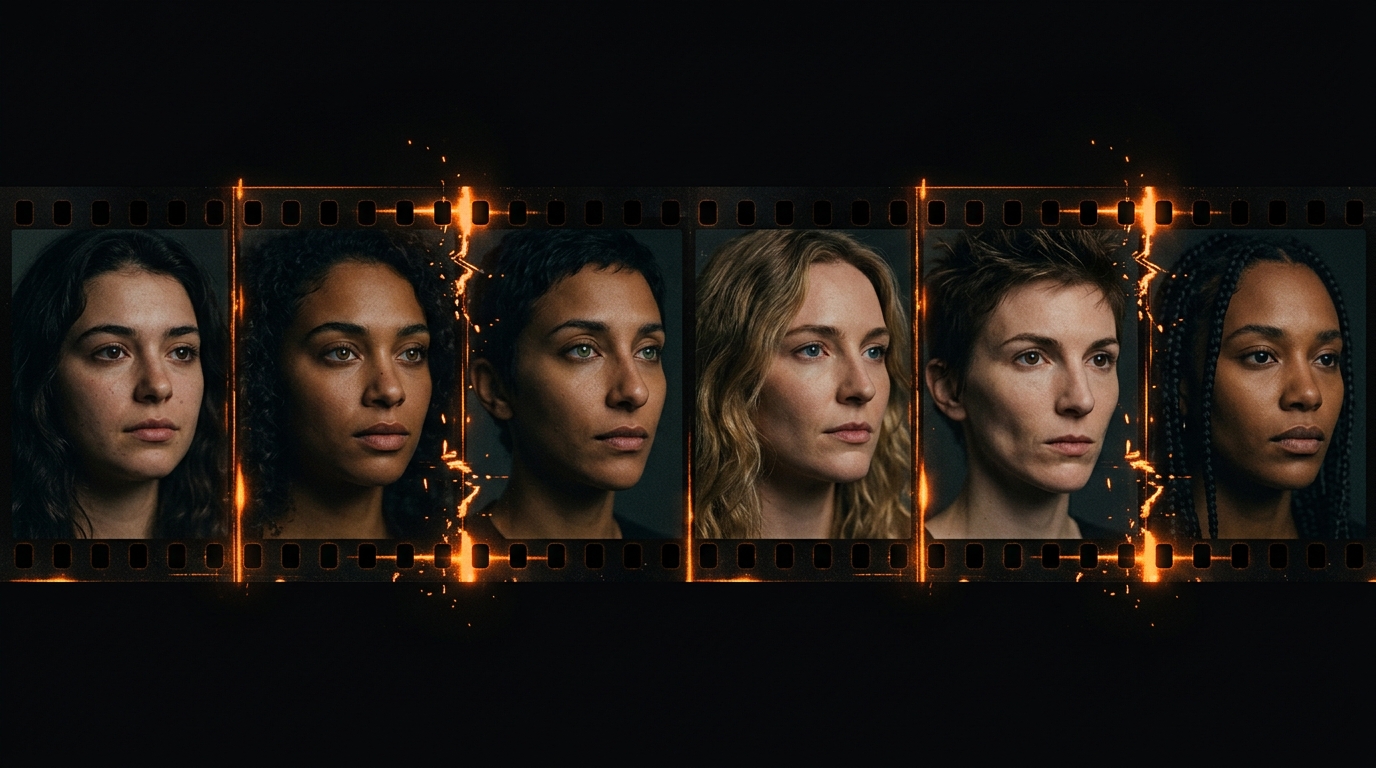
Identity drift: the same character prompt produces a different face in every frame
AI Character Consistency in Video: The Complete Guide
Character consistency is the single biggest unsolved problem in AI video generation. You can generate a stunning 4-second clip of a character, but the moment you generate a second clip, that character looks like a different person. Different jawline, different eye spacing, different hair color, different clothing details. For any storytelling application - short films, series, brand content, animations - this makes most AI video tools functionally unusable.
This guide explains why character consistency is hard, what the current approaches are, why most of them fail, and how Visual DNA offers a fundamentally different architecture.
Key takeaway: Character consistency means a character looks identifiably like the same individual across every scene - preserving facial identity, body proportions, clothing, and distinguishing features regardless of angle or lighting.
Character consistency means a character looks identifiably like the same individual across multiple generated scenes, camera angles, lighting conditions, and poses. In traditional animation or live-action film, this is trivially achieved - you draw the same character model or film the same actor. In AI video generation, it is extremely difficult because of how diffusion models work.
Clothing and accessories - exact garments, colors, patterns, jewelry
Distinguishing features - scars, tattoos, unique hairstyles
Style coherence - the character should feel like it belongs in the same visual universe across scenes
DNA helix visualization representing Visual DNA character attributes
How identity drift accumulates across scenes - the same prompt produces increasingly different faces
Why Character Consistency Is Hard
Key takeaway: Diffusion models have no concept of individual identity in their latent space - each generation samples a different point, producing a different person even from the same prompt.
The Latent Space Problem
Diffusion models generate images and video by iteratively denoising samples from a latent space - a high-dimensional mathematical representation of visual concepts. When you prompt "a woman with red hair in a blue jacket," the model samples from the region of latent space that matches that description. But that region contains millions of possible women with red hair in blue jackets. Each generation samples a different point, producing a different individual.
There is no "identity coordinate" in latent space. The concept of "this specific person" doesn't exist as a dimension the model can lock onto.
Identity Drift
Even when using techniques to anchor a character's appearance, identity drift occurs over sequential generations. Small variations accumulate: the nose gets slightly wider, the eyes shift from green to hazel, the jacket changes shade. By scene 5 or 6, the character is noticeably different from scene 1, even if each adjacent pair of scenes looks "close enough."
This is analogous to the game of telephone - small transmission errors compound into large deviations.
The Multi-View Problem
A character needs to look consistent from the front, side, three-quarter view, from above, and from behind. Diffusion models learn these views independently from training data, and the mapping between views for a specific character identity is not explicitly learned. A model can generate a convincing front view and a convincing side view, but they will rarely look like the same person.
Lighting and Environment Interaction
Characters interact with their environments through lighting, shadows, and reflections. A character in a sunlit park should look like the same person in a dimly lit room - just with different lighting. Most models regenerate the character for each environment, losing identity in the process.
Current Approaches (and Why They Fall Short)
Key takeaway: LoRA, IP-Adapter, reference images, and seed locking each address symptoms of identity drift but none solve the underlying architectural gap in how diffusion models represent identity.
LoRA Fine-Tuning
What it is: LoRA (Low-Rank Adaptation) fine-tunes a small subset of model weights on a set of reference images of a specific character. This "teaches" the model what the character looks like.
How it works: You provide 10-30 images of the character from different angles and expressions. The LoRA training process adjusts specific weight matrices so the model learns to generate that character when triggered by a specific token.
Why it falls short:
Requires significant training time (30 minutes to several hours)
Overfitting causes the character to appear in the same pose and expression repeatedly
Underfitting produces a character that only vaguely resembles the reference
Every new character requires a separate LoRA training run
LoRAs are model-specific - they break when the base model updates
Not practical for rapid iteration or real-time creative workflows
Reference Images / Image-to-Video
What it is: Providing a reference image of the character alongside the text prompt, expecting the model to maintain that appearance.
How it works: The reference image is encoded and injected into the generation pipeline as conditioning information, theoretically guiding the output toward matching the reference.
Why it falls short:
Models treat the reference as a "suggestion" rather than a strict constraint
Pose changes cause the model to deviate significantly from the reference
Only the most prominent features are preserved; subtle details drift
No mechanism for preserving identity across multiple scenes - each generation uses the reference independently
IP-Adapter and Face Embeddings
What it is: IP-Adapter extracts image embeddings from a reference and injects them into the cross-attention layers of the diffusion model. Face-specific variants (e.g., IP-Adapter-FaceID) use facial recognition embeddings.
How it works: A CLIP or face recognition model creates a numerical representation of the reference face. This embedding is injected into the generation process to guide the output toward matching facial features.
Why it falls short:
Preserves general facial structure but loses fine details
Struggles with non-frontal angles
Clothing, accessories, and body proportions are not captured by face embeddings
The "style" of the embedding often bleeds into the scene, making all characters look similar
Quality degrades significantly with stylized or animated characters
Seed Locking and Prompt Engineering
What it is: Using the same random seed and detailed prompts to try to reproduce the same character.
Why it falls short:
Extremely fragile - changing any word in the prompt shifts the output dramatically
Cannot handle different poses, angles, or environments
Not a real solution, more of a workaround that occasionally produces acceptable results
Comparing character consistency approaches: setup complexity, quality, and attribute coverage
The Character Consistency Benchmark: Where Tools Stand
Key takeaway: The gap is architectural, not incremental - Pika and Sora expose no cross-generation identity mechanism at all, and Runway's reference image has to be re-supplied and re-matched on every generation.
Independent benchmarks have quantified the consistency problem:
Pika scored 1.4 out of 10 on cross-scene character identity preservation in a 2025 benchmark study, meaning characters were nearly unrecognizable between scenes.
Runway holds a 2.5 out of 5 average on Trustpilot, with character inconsistency cited as one of the most frequent complaints from paying subscribers.
Sora produces impressive individual clips but provides no mechanism for cross-generation identity, scoring effectively 0 on multi-scene consistency without manual intervention.
These scores reflect the fundamental limitation: these tools were built for single-clip generation and have not solved the multi-scene identity problem.
How Visual DNA Is Different
Key takeaway: Visual DNA treats character identity as an architectural principle - analyzing 40+ visual attributes independently and applying them as generation constraints, not suggestions.
Visual DNA, developed by Artiroom, takes a fundamentally different approach. Rather than trying to bolt consistency onto an existing frame-by-frame generation pipeline, Visual DNA treats character identity as an architectural principle.
What Visual DNA Analyzes
When you create a character in Artiroom, the Visual DNA system extracts and catalogs 40+ visual attributes:
Coloring - exact skin tone values, hair color and highlights, eye color, eyebrow color
Body proportions - shoulder width relative to height, limb ratios, build classification
Clothing specifics - fabric type, color values, pattern geometry, fit characteristics
Texture and material - skin texture, hair texture (curly, straight, wavy), fabric weave
Distinguishing features - scars, tattoos, birthmarks, jewelry, piercings, glasses
Lighting response - how the character's materials respond to different lighting conditions
How It Preserves Identity
Unlike reference image approaches that provide a single conditioning signal, Visual DNA creates a multi-dimensional identity profile that constrains the generation across all relevant attribute dimensions simultaneously. Each scene generation is conditioned not just on "what the character looks like" but on the complete set of physical characteristics that define the character.
This means:
The character maintains identity across different camera angles because the 3D structural attributes (proportions, geometry) are preserved independently of view angle.
The character looks correct in different lighting because material and color attributes include lighting response characteristics.
Clothing stays consistent because fabric, color, and fit are tracked as independent attributes rather than being lumped into a general "appearance" embedding.
Fine details persist because distinguishing features are explicitly cataloged rather than left to a lossy embedding to capture.
| Approach | Training Required | Fine Detail | Multi-Angle | Speed | Clothing |
|----------|------------------|-------------|-------------|-------|----------|
| LoRA | 30+ min per character | Medium | Poor | Slow | Poor |
| IP-Adapter | None | Low | Poor | Fast | None |
| Reference Image | None | Low-Medium | Poor | Fast | Minimal |
| Visual DNA | None | High | Strong | Fast | Full |
Practical Implications
Key takeaway: Character consistency transforms AI video from a clip-generation novelty into a genuine filmmaking, branding, and series production tool.
For Short Film Creators
Character consistency transforms AI video from a clip-generation toy into a filmmaking tool. With Visual DNA, you can plan a 20-scene short film knowing that your protagonist will look like the same person from the opening shot to the final frame.
For Brand Content
Brand mascots and spokescharacters require absolute consistency. A cartoon brand ambassador that changes face between Instagram posts destroys brand recognition. Visual DNA enables serialized brand content with reliable character identity.
For Animation
Animated characters require even more precise consistency than photorealistic ones, because viewers are highly sensitive to style changes in stylized content. Visual DNA's attribute-level tracking handles stylized characters as effectively as photorealistic ones.
For Series and Episodic Content
The rise of AI-generated series on YouTube and social platforms demands characters that audiences can follow across episodes. Without consistency, there is no audience attachment, and without attachment, there is no viewership growth.
Key takeaway: Character consistency will be the primary differentiator in AI video for the next 2-3 years as single-clip quality converges across providers.
Character consistency will be the primary differentiator in AI video for the next two to three years. As single-clip quality converges across providers, the ability to tell coherent multi-scene stories will separate production-ready tools from toys.
Expect to see every major AI video platform announce some form of character consistency feature by late 2026. The question is whether they'll solve it at the architectural level - as Visual DNA does - or bolt on partial solutions that inherit the limitations of their existing pipelines.
For creators working today, the choice is clear: if your work requires characters that look the same across scenes, you need a tool that was built for that purpose from the ground up.
The Bottom Line
Summary: Character consistency is the defining challenge in AI video generation - diffusion models lack a native concept of identity, causing characters to change between scenes. Artiroom's Visual DNA solves this architecturally by tracking 40+ visual attributes as independent generation constraints, reused across every scene rather than re-supplied per generation.