By Camilo Villa, Founder, Artiroom. Published 2026-03-24. 9 min read.
Visual DNA is Artiroom's proprietary technology for maintaining character consistency in AI video. It analyzes 40+ visual attributes to preserve identity across scenes, angles, and lighting conditions.
What is Visual DNA in AI Video Generation?
Visual DNA is a character consistency technology developed by Artiroom that maintains a character's visual identity across multiple AI-generated video scenes. It works by analyzing and cataloging 40+ distinct visual attributes of a character - from facial geometry and skin tones to clothing textures and lighting response - and using that attribute profile as an architectural constraint during every scene generation.
The result: a character that looks like the same individual in scene 1 and scene 50, regardless of camera angle, lighting condition, pose, or environment.
In this guide:
- [The Problem Visual DNA Solves](the-problem-visual-dna-solves)
- [How Visual DNA Works](how-visual-dna-works)
- [Visual DNA vs. Alternative Approaches](visual-dna-vs-alternative-approaches)
- [Use Cases for Visual DNA](use-cases-for-visual-dna)
- [The Technology Behind the Name](the-technology-behind-the-name)
- [Getting Started with Visual DNA](getting-started-with-visual-dna)
- [The Future of Visual DNA](the-future-of-visual-dna)
- [The Bottom Line](the-bottom-line)
---
The Problem Visual DNA Solves
> Key takeaway: AI video generators produce stunning individual clips, but generating two clips of the same character yields two different people - Visual DNA eliminates this identity drift at the architectural level.
AI video generators produce stunning individual clips. But ask them to generate two clips of the same character, and you get two different people. The eyes change shape, the jawline shifts, the hair color drifts, the clothing transforms. This is called identity drift, and it's the single biggest barrier to using AI video for storytelling.
The root cause is architectural. Diffusion models - the technology behind AI video generation - work by sampling from a latent space. This space doesn't contain a dimension for "individual identity." When you prompt "a woman with brown hair in a red dress," you get one of millions of possible women matching that description. The next generation produces a different one.
Previous attempts to solve this - LoRA fine-tuning, reference images, IP-Adapter face embeddings - treat the symptom rather than the disease. They add a loose constraint to the generation process without fundamentally addressing the lack of identity representation.
Visual DNA takes a different approach. Instead of trying to constrain a system that wasn't designed for identity preservation, it builds identity into the generation architecture.
[Read our complete technical guide to character consistency challenges](/blog/ai-character-consistency-complete-guide)
---
How Visual DNA Works
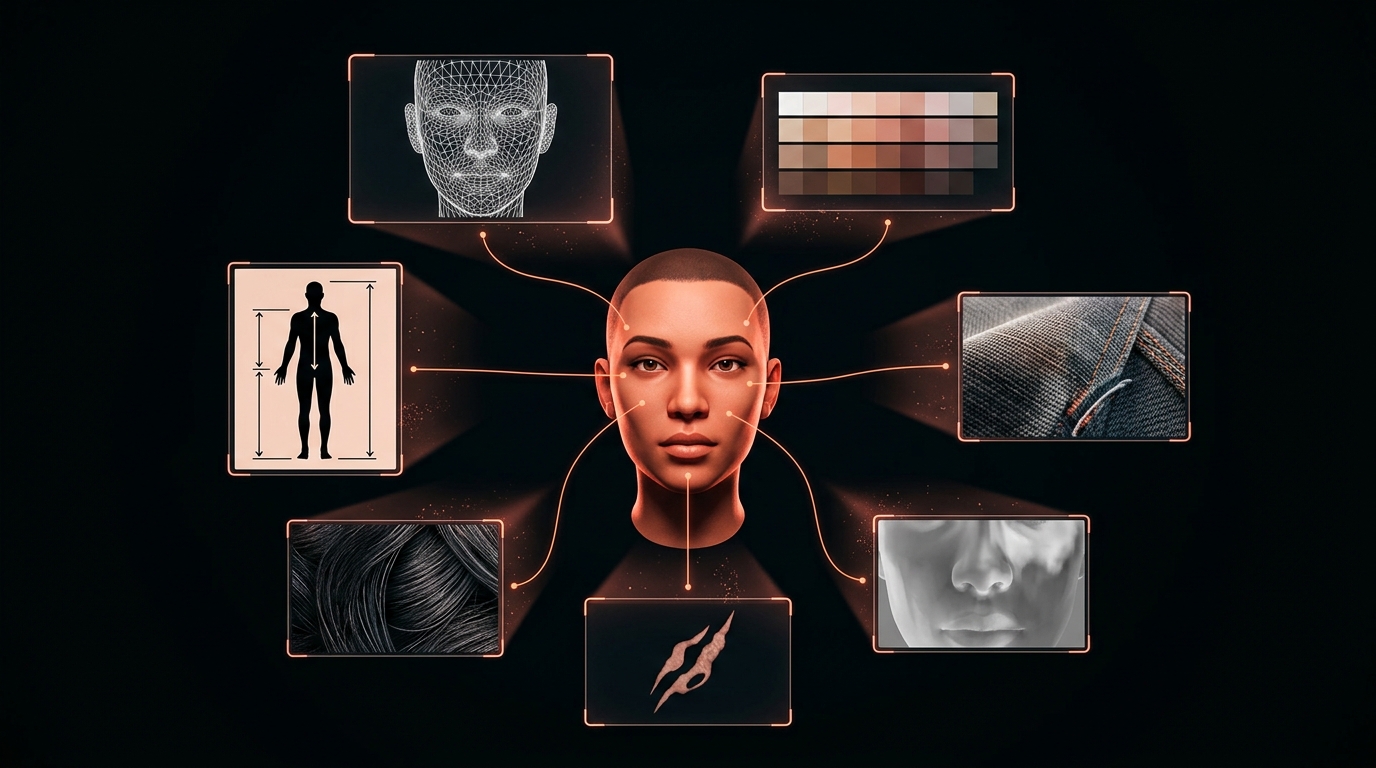
> Key takeaway: Visual DNA extracts 40+ attributes across facial geometry, coloring, body structure, clothing, distinguishing features, and material response - then applies each as an independent generation constraint.
Attribute Extraction
When you create a character in Artiroom, the Visual DNA system performs a comprehensive analysis. Whether you provide reference images, text descriptions, or use the manual attribute editor, the system extracts and catalogs attributes across multiple dimensions:
Facial Geometry (12+ attributes)
- Eye shape, size, spacing, and color
- Nose bridge width, tip shape, and nostril structure
- Jawline curvature and chin shape
- Cheekbone prominence and face width
- Lip shape, fullness, and proportions
- Ear shape and positioning
- Eyebrow shape, thickness, and arch
Coloring (8+ attributes)
- Skin tone (precise value, not a general category)
- Skin undertone (warm, cool, neutral)
- Hair base color and highlight pattern
- Eye color with iris detail
- Lip color
- Eyebrow color
- Freckles, moles, or skin markings
Body Structure (6+ attributes)
- Height estimation relative to environment
- Shoulder width relative to height
- Build classification (lean, athletic, stocky, etc.)
- Limb proportions
- Posture characteristics
- Hand size and shape
Clothing and Accessories (8+ attributes)
- Garment types and layer order
- Fabric type per garment (cotton, leather, silk, denim, etc.)
- Color values per garment
- Pattern geometry (stripes, plaid, solid, etc.)
- Fit characteristics (loose, tailored, tight)
- Accessories: glasses, jewelry, watches, bags
- Footwear type and color
Distinguishing Features (4+ attributes)
- Scars, tattoos, birthmarks
- Unique hairstyle elements (streaks, shaved sections, braids)
- Piercings
- Prosthetics or mobility aids
Material Response (4+ attributes)
- How skin reflects different lighting conditions
- Hair shininess and light absorption
- Fabric light response (matte, satin, reflective)
- Accessory material properties (metallic, glass, plastic)


---
Profile Construction
> Key takeaway: Unlike single embedding vectors that compress identity into a lossy number sequence, Visual DNA preserves each attribute as an independently addressable dimension - maintaining granular detail.
These extracted attributes are compiled into a Visual DNA profile - a structured, multi-dimensional representation of the character's complete visual identity. Unlike a single embedding vector (which is what IP-Adapter and similar approaches use), a Visual DNA profile preserves each attribute as an independently addressable dimension.
This distinction matters. A single embedding vector compresses all identity information into one number sequence, losing fine details in the process. Visual DNA maintains granular detail because each attribute is stored and applied separately.

---
Generation Conditioning
When you generate a scene containing a character with a Visual DNA profile, the generation process receives the complete attribute set as constraints. Rather than using a single reference image or a single embedding as a soft guide, the system applies specific constraints across all relevant attribute dimensions:
- Facial geometry constraints ensure the face structure matches the profile at any angle
- Coloring constraints ensure skin tone, hair color, and eye color remain exact
- Clothing constraints ensure garments match in type, color, fabric, and fit
- Distinguishing feature constraints ensure unique identifiers are present
Because these constraints operate independently, the system can handle novel scenarios gracefully. A character viewed from behind still maintains correct hair color, clothing, and body proportions - even though the face isn't visible - because those attributes are independently constrained.
---
Visual DNA vs. Alternative Approaches
> Key takeaway: Visual DNA requires no training, preserves clothing and body details (not just faces), handles multiple angles, and works across model updates - advantages no alternative approach matches.
vs. LoRA Fine-Tuning
LoRA modifies model weights to "learn" a character, requiring 10-30 reference images and 30+ minutes of training per character. It creates a model-specific modification that breaks when the base model updates.
Visual DNA requires no training. Define the character once, and the profile works immediately and indefinitely. It's also model-agnostic in principle - the attribute profile can be applied as constraints to any generation pipeline.
vs. IP-Adapter / Face Embeddings
IP-Adapter extracts a single embedding vector from a reference image and injects it into the generation process. This captures rough facial similarity but loses fine details, especially non-facial attributes like clothing and body proportions.
Visual DNA captures 40+ independent attributes with granular precision. Clothing, body structure, and distinguishing features are preserved with the same fidelity as facial features.
vs. Reference Images
Reference image conditioning provides the model with a visual target but treats it as a suggestion rather than a constraint. The model can and does deviate, especially with pose or angle changes.
Visual DNA profiles are applied as constraints, not suggestions. The generation is bounded by the attribute profile, dramatically reducing deviation.
Comparison Summary
| Capability | LoRA | IP-Adapter | Reference Image | Visual DNA |
|-----------|------|------------|-----------------|------------|
| Setup time | 30+ min | Instant | Instant | Instant |
| Facial accuracy | Medium | Medium-Low | Low-Medium | High |
| Body consistency | Poor | None | Minimal | High |
| Clothing consistency | Poor | None | Minimal | High |
| Multi-angle support | Poor | Poor | Poor | Strong |
| Distinguishing features | Variable | None | Minimal | Preserved |
| Works across model updates | No | Yes | Yes | Yes |
[See how Visual DNA performs against every major platform](/blog/artiroom-vs-runway-vs-sora-vs-kling)
---
Use Cases for Visual DNA
> Key takeaway: Visual DNA unlocks AI video for any application requiring character identity across scenes - from short films and brand mascots to episodic series and game prototyping.
AI Short Films
The primary use case. Visual DNA enables creators to produce short films where characters maintain identity from the first scene to the last. This transforms AI video from a clip-generation tool into a filmmaking medium.
Brand Content and Mascots
Brand characters need absolute consistency. A mascot that changes face between social media posts erodes brand recognition. Visual DNA ensures brand characters are pixel-consistent across every content piece.
Episodic and Series Content
YouTube series, social media episodes, and serialized storytelling require characters that audiences recognize and follow. Visual DNA profiles persist across projects, enabling true series production.
Animated Content
Character consistency is arguably more critical in animation than in photorealistic content. Audiences are highly sensitive to style inconsistencies in stylized art. Visual DNA's attribute-level tracking works across art styles - anime, cartoon, painterly, and photorealistic.
Game and Interactive Prototyping
Game developers and interactive media creators use AI video for prototyping characters and cinematics. Visual DNA enables rapid iteration on character designs with guaranteed consistency across test scenarios.
Storyboarding and Pre-Visualization
Directors and producers use AI-generated storyboards to previsualize films. Visual DNA ensures the storyboard characters match across all frames, making the previsualization accurate and useful for production planning.
[Follow our step-by-step tutorial to create your first AI film with Visual DNA](/blog/how-to-create-ai-short-film)
---
The Technology Behind the Name
> Key takeaway: Like biological DNA encoding instructions for physical traits, Visual DNA encodes specific instructions for every visual attribute that defines a character - ensuring identity persists as new scenes are generated.
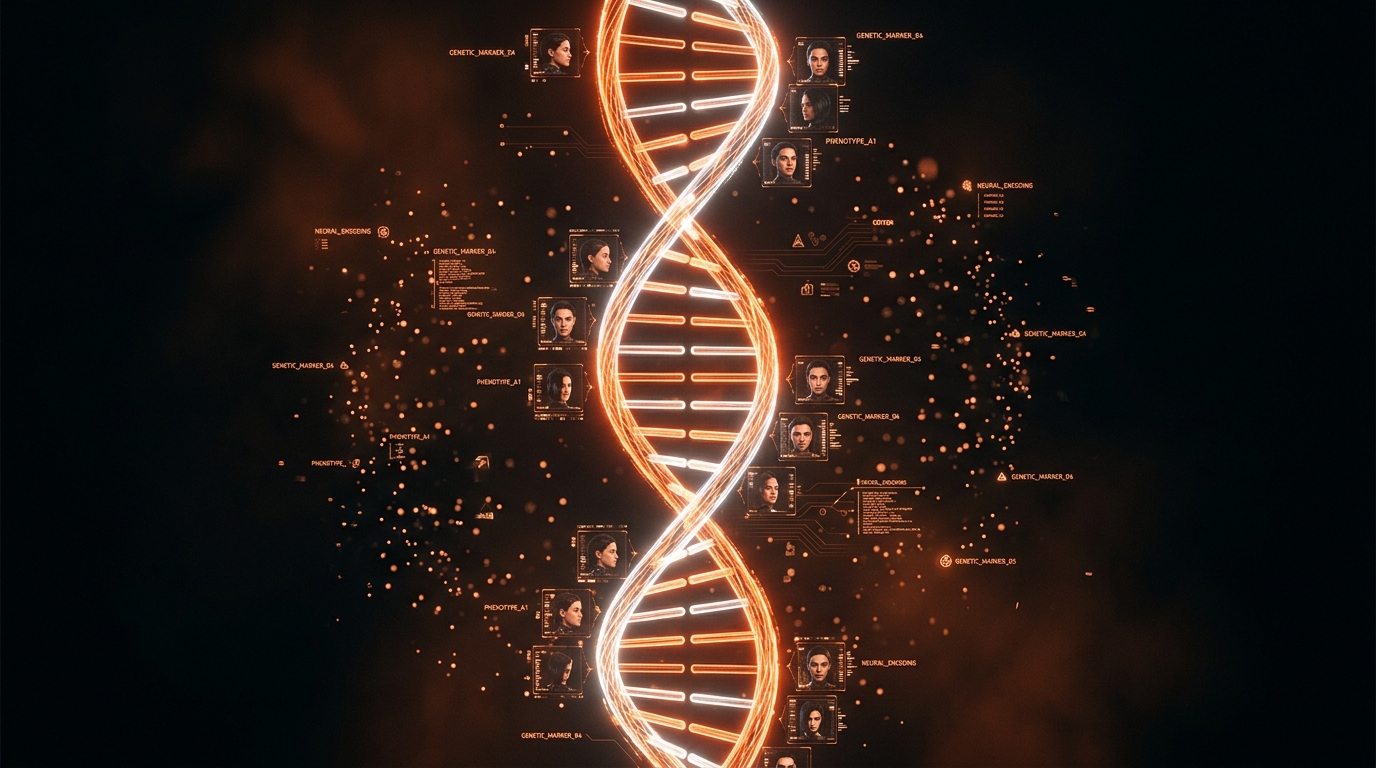
The name "Visual DNA" is deliberate. In biology, DNA is the molecular blueprint that ensures an organism maintains its identity as cells divide and grow. Similarly, Visual DNA is the digital blueprint that ensures an AI-generated character maintains its identity as new scenes are generated.
Just as biological DNA encodes specific instructions for eye color, bone structure, and skin pigmentation, Visual DNA encodes specific instructions for every visual attribute that defines a character. And just as biological DNA is read whenever new cells are created, Visual DNA is read whenever new scenes are generated.
The analogy extends to uniqueness: every person's DNA is unique, and every character's Visual DNA profile is unique. No two profiles produce the same character, and the same profile always produces the same character.
---
Getting Started with Visual DNA
Using Visual DNA in Artiroom is straightforward:
1. Navigate to Character Studio in your Artiroom dashboard
2. Create a new character by uploading reference images, writing a description, or using the attribute editor
3. Review the Visual DNA profile - preview the character from multiple angles
4. Refine as needed - adjust specific attributes until the character matches your vision
5. Use in any project - the Visual DNA profile is available in all generation tools
The profile is created in minutes and persists indefinitely across all your projects.
---
The Future of Visual DNA
> Key takeaway: The Visual DNA roadmap includes dynamic attribute evolution, relational consistency between characters, cross-style identity transfer, and cross-platform portability as an open standard.
Visual DNA represents the current state of character consistency technology, but the roadmap extends further:
- Dynamic attribute evolution - Characters that age, change hairstyles, or gain scars while maintaining core identity
- Relational consistency - Characters that maintain consistent spatial relationships to each other (height differences, etc.)
- Style transfer with identity preservation - Moving a character between art styles while maintaining identity
- Cross-platform portability - Visual DNA profiles as a standard that works across different generation platforms
Character identity is a fundamental building block of storytelling. Visual DNA is the technology that brings that building block to AI-generated media.
[Read our analysis of where the entire AI filmmaking industry is heading](/blog/state-of-ai-filmmaking-2026)
---
The Bottom Line
> Summary: Visual DNA is Artiroom's character consistency technology that analyzes 40+ independent visual attributes - from facial geometry to clothing textures - and applies them as architectural generation constraints, solving the identity drift problem that makes most AI video tools unusable for multi-scene storytelling.
Frequently Asked Questions
What is Visual DNA?
Visual DNA is Artiroom's character consistency technology that analyzes and preserves 40+ visual attributes - facial geometry, coloring, body proportions, clothing, and distinguishing features - to maintain a character's identity across all AI-generated video scenes.
How is Visual DNA different from LoRA or IP-Adapter?
Unlike LoRA (which requires training time and breaks with model updates) or IP-Adapter (which uses a single lossy embedding), Visual DNA tracks 40+ attributes independently with no training required. It preserves clothing, body structure, and fine details that other approaches lose.
Do I need to train Visual DNA for each character?
No. Visual DNA requires zero training time. You provide reference images, text descriptions, or use the attribute editor, and the profile is generated in minutes. It works immediately and persists across all your projects indefinitely.
Does Visual DNA work with different art styles?
Yes. Visual DNA profiles work across photorealistic, anime, cartoon, painterly, and other art styles. The attribute-level tracking adapts to each style while preserving the character's core identity features, proportions, and distinguishing characteristics.
Can Visual DNA maintain consistency across different camera angles?
Yes. Because Visual DNA tracks 3D structural attributes like facial geometry and body proportions independently from any specific view, characters maintain identity across front, side, three-quarter, and back views as well as high and low angles.
Visual DNAcharacter consistencyAI technology
What is Visual DNA in AI Video Generation?
Visual DNA is Artiroom's proprietary technology for maintaining character consistency in AI video. It analyzes 40+ visual attributes to preserve identity across scenes, angles, and lighting conditions.
Camilo Villa|March 24, 2026|Updated October 7, 2026|9 min read
Visual DNA — the technology that preserves character identity across every scene
What is Visual DNA in AI Video Generation?
Visual DNA is a character consistency technology developed by Artiroom that maintains a character's visual identity across multiple AI-generated video scenes. It works by analyzing and cataloging 40+ distinct visual attributes of a character - from facial geometry and skin tones to clothing textures and lighting response - and using that attribute profile as an architectural constraint during every scene generation.
The result: a character that looks like the same individual in scene 1 and scene 50, regardless of camera angle, lighting condition, pose, or environment.
Key takeaway: AI video generators produce stunning individual clips, but generating two clips of the same character yields two different people - Visual DNA eliminates this identity drift at the architectural level.
AI video generators produce stunning individual clips. But ask them to generate two clips of the same character, and you get two different people. The eyes change shape, the jawline shifts, the hair color drifts, the clothing transforms. This is called identity drift, and it's the single biggest barrier to using AI video for storytelling.
The root cause is architectural. Diffusion models - the technology behind AI video generation - work by sampling from a latent space. This space doesn't contain a dimension for "individual identity." When you prompt "a woman with brown hair in a red dress," you get one of millions of possible women matching that description. The next generation produces a different one.
Previous attempts to solve this - LoRA fine-tuning, reference images, IP-Adapter face embeddings - treat the symptom rather than the disease. They add a loose constraint to the generation process without fundamentally addressing the lack of identity representation.
Visual DNA takes a different approach. Instead of trying to constrain a system that wasn't designed for identity preservation, it builds identity into the generation architecture.
Key takeaway: Visual DNA extracts 40+ attributes across facial geometry, coloring, body structure, clothing, distinguishing features, and material response - then applies each as an independent generation constraint.
Attribute Extraction
When you create a character in Artiroom, the Visual DNA system performs a comprehensive analysis. Whether you provide reference images, text descriptions, or use the manual attribute editor, the system extracts and catalogs attributes across multiple dimensions:
Facial Geometry (12+ attributes)
Eye shape, size, spacing, and color
Nose bridge width, tip shape, and nostril structure
Fabric type per garment (cotton, leather, silk, denim, etc.)
Color values per garment
Pattern geometry (stripes, plaid, solid, etc.)
Fit characteristics (loose, tailored, tight)
Accessories: glasses, jewelry, watches, bags
Footwear type and color
Distinguishing Features (4+ attributes)
Scars, tattoos, birthmarks
Unique hairstyle elements (streaks, shaved sections, braids)
Piercings
Prosthetics or mobility aids
Material Response (4+ attributes)
How skin reflects different lighting conditions
Hair shininess and light absorption
Fabric light response (matte, satin, reflective)
Accessory material properties (metallic, glass, plastic)
Exploded diagram showing 40+ visual attributes analyzed by Visual DNA
The 40+ visual attributes Visual DNA tracks across 6 categories
Profile Construction
Key takeaway: Unlike single embedding vectors that compress identity into a lossy number sequence, Visual DNA preserves each attribute as an independently addressable dimension - maintaining granular detail.
These extracted attributes are compiled into a Visual DNA profile - a structured, multi-dimensional representation of the character's complete visual identity. Unlike a single embedding vector (which is what IP-Adapter and similar approaches use), a Visual DNA profile preserves each attribute as an independently addressable dimension.
This distinction matters. A single embedding vector compresses all identity information into one number sequence, losing fine details in the process. Visual DNA maintains granular detail because each attribute is stored and applied separately.
Single embedding vs Visual DNA: lossy compression vs lossless multi-channel preservation
Generation Conditioning
When you generate a scene containing a character with a Visual DNA profile, the generation process receives the complete attribute set as constraints. Rather than using a single reference image or a single embedding as a soft guide, the system applies specific constraints across all relevant attribute dimensions:
Facial geometry constraints ensure the face structure matches the profile at any angle
Coloring constraints ensure skin tone, hair color, and eye color remain exact
Clothing constraints ensure garments match in type, color, fabric, and fit
Distinguishing feature constraints ensure unique identifiers are present
Because these constraints operate independently, the system can handle novel scenarios gracefully. A character viewed from behind still maintains correct hair color, clothing, and body proportions - even though the face isn't visible - because those attributes are independently constrained.
Visual DNA vs. Alternative Approaches
Key takeaway: Visual DNA requires no training, preserves clothing and body details (not just faces), handles multiple angles, and works across model updates - advantages no alternative approach matches.
vs. LoRA Fine-Tuning
LoRA modifies model weights to "learn" a character, requiring 10-30 reference images and 30+ minutes of training per character. It creates a model-specific modification that breaks when the base model updates.
Visual DNA requires no training. Define the character once, and the profile works immediately and indefinitely. It's also model-agnostic in principle - the attribute profile can be applied as constraints to any generation pipeline.
vs. IP-Adapter / Face Embeddings
IP-Adapter extracts a single embedding vector from a reference image and injects it into the generation process. This captures rough facial similarity but loses fine details, especially non-facial attributes like clothing and body proportions.
Visual DNA captures 40+ independent attributes with granular precision. Clothing, body structure, and distinguishing features are preserved with the same fidelity as facial features.
vs. Reference Images
Reference image conditioning provides the model with a visual target but treats it as a suggestion rather than a constraint. The model can and does deviate, especially with pose or angle changes.
Visual DNA profiles are applied as constraints, not suggestions. The generation is bounded by the attribute profile, dramatically reducing deviation.
Comparison Summary
| Capability | LoRA | IP-Adapter | Reference Image | Visual DNA |
|-----------|------|------------|-----------------|------------|
| Setup time | 30+ min | Instant | Instant | Instant |
| Facial accuracy | Medium | Medium-Low | Low-Medium | High |
| Body consistency | Poor | None | Minimal | High |
| Clothing consistency | Poor | None | Minimal | High |
| Multi-angle support | Poor | Poor | Poor | Strong |
| Distinguishing features | Variable | None | Minimal | Preserved |
| Works across model updates | No | Yes | Yes | Yes |
Key takeaway: Visual DNA unlocks AI video for any application requiring character identity across scenes - from short films and brand mascots to episodic series and game prototyping.
AI Short Films
The primary use case. Visual DNA enables creators to produce short films where characters maintain identity from the first scene to the last. This transforms AI video from a clip-generation tool into a filmmaking medium.
Brand Content and Mascots
Brand characters need absolute consistency. A mascot that changes face between social media posts erodes brand recognition. Visual DNA ensures brand characters are pixel-consistent across every content piece.
Episodic and Series Content
YouTube series, social media episodes, and serialized storytelling require characters that audiences recognize and follow. Visual DNA profiles persist across projects, enabling true series production.
Animated Content
Character consistency is arguably more critical in animation than in photorealistic content. Audiences are highly sensitive to style inconsistencies in stylized art. Visual DNA's attribute-level tracking works across art styles - anime, cartoon, painterly, and photorealistic.
Game and Interactive Prototyping
Game developers and interactive media creators use AI video for prototyping characters and cinematics. Visual DNA enables rapid iteration on character designs with guaranteed consistency across test scenarios.
Storyboarding and Pre-Visualization
Directors and producers use AI-generated storyboards to previsualize films. Visual DNA ensures the storyboard characters match across all frames, making the previsualization accurate and useful for production planning.
Key takeaway: Like biological DNA encoding instructions for physical traits, Visual DNA encodes specific instructions for every visual attribute that defines a character - ensuring identity persists as new scenes are generated.
The name "Visual DNA" is deliberate. In biology, DNA is the molecular blueprint that ensures an organism maintains its identity as cells divide and grow. Similarly, Visual DNA is the digital blueprint that ensures an AI-generated character maintains its identity as new scenes are generated.
Just as biological DNA encodes specific instructions for eye color, bone structure, and skin pigmentation, Visual DNA encodes specific instructions for every visual attribute that defines a character. And just as biological DNA is read whenever new cells are created, Visual DNA is read whenever new scenes are generated.
The analogy extends to uniqueness: every person's DNA is unique, and every character's Visual DNA profile is unique. No two profiles produce the same character, and the same profile always produces the same character.
Getting Started with Visual DNA
Using Visual DNA in Artiroom is straightforward:
Navigate to Character Studio in your Artiroom dashboard
Create a new character by uploading reference images, writing a description, or using the attribute editor
Review the Visual DNA profile - preview the character from multiple angles
Refine as needed - adjust specific attributes until the character matches your vision
Use in any project - the Visual DNA profile is available in all generation tools
The profile is created in minutes and persists indefinitely across all your projects.
The Future of Visual DNA
Key takeaway: The Visual DNA roadmap includes dynamic attribute evolution, relational consistency between characters, cross-style identity transfer, and cross-platform portability as an open standard.
Visual DNA represents the current state of character consistency technology, but the roadmap extends further:
Dynamic attribute evolution - Characters that age, change hairstyles, or gain scars while maintaining core identity
Relational consistency - Characters that maintain consistent spatial relationships to each other (height differences, etc.)
Style transfer with identity preservation - Moving a character between art styles while maintaining identity
Cross-platform portability - Visual DNA profiles as a standard that works across different generation platforms
Character identity is a fundamental building block of storytelling. Visual DNA is the technology that brings that building block to AI-generated media.
Summary: Visual DNA is Artiroom's character consistency technology that analyzes 40+ independent visual attributes - from facial geometry to clothing textures - and applies them as architectural generation constraints, solving the identity drift problem that makes most AI video tools unusable for multi-scene storytelling.