By Camilo Villa, Founder, Artiroom. Published 2026-03-24. 12 min read.
An in-depth analysis of where AI filmmaking stands in 2026: market projections, technology trends, the tool landscape, creator economy implications, and the unsolved problems shaping the next era.
The State of AI Filmmaking in 2026
Three years ago, AI video generation was a research curiosity. Two years ago, it became a consumer product. Today, it is an industry. The question is no longer whether AI can generate video - it obviously can. The question is whether AI can make films: coherent, intentional, emotionally resonant visual stories with consistent characters, narrative arcs, and artistic vision.
This analysis examines where AI filmmaking stands in March 2026 - the market, the technology, the tools, the creators, and the problems that remain unsolved.
In this guide:
- [Market Overview](market-overview)
- [Technology Trends](technology-trends)
- [The Tool Landscape](the-tool-landscape)
- [Unsolved Problems](unsolved-problems)
- [Where the Industry Is Heading](where-the-industry-is-heading)
- [Artiroom's Position](artirooms-position)
- [The Bottom Line](the-bottom-line)
---
Market Overview
> Key takeaway: The AI video generation market is projected to grow from $550 million in 2024 to over $3 billion by 2033 at 18% CAGR, with the filmmaking-specific segment growing even faster.
Size and Growth
The AI video generation market was valued at approximately $550 million in 2024 and is projected to exceed $3 billion by 2033, representing a compound annual growth rate (CAGR) of approximately 18%. These figures encompass the full spectrum of AI video applications, from enterprise marketing automation to individual creator tools.
The filmmaking-specific segment - tools and platforms used to create narrative video content with AI - is growing faster than the overall market, driven by:
- Exploding demand for video content across platforms (YouTube, TikTok, Instagram Reels)
- Falling costs of AI video generation
- Rising quality that approaches "good enough" for professional use
- Creator economy growth that rewards prolific, consistent content production
Investment Landscape
Venture capital investment in AI video and filmmaking tools totaled over $2.1 billion in 2025, with major rounds including Runway's Series D, Pika's Series B, and significant funding for emerging players like Artiroom and several stealth-mode startups focused on character consistency and narrative structure.
Enterprise spending on AI video tools is projected to reach $800 million in 2026, as marketing departments, studios, and agencies integrate AI generation into their production workflows.


Creator Economy Impact
An estimated 12 million creators worldwide now use AI video tools at least monthly, up from approximately 3 million in 2024. The fastest-growing segment is AI-native creators - individuals who build entire channels and content businesses around AI-generated video rather than using AI as a supplement to traditional production.
YouTube channels featuring AI-generated content have grown 340% year-over-year in subscriber counts, with several channels exceeding 1 million subscribers. The monetization question has shifted from "can you make money with AI video?" to "how much?"
---
Technology Trends
> Key takeaway: Single-clip quality has converged among top platforms - the differentiator has moved to character consistency, story-to-video pipelines, and multi-scene coherence.
1. Character Consistency Is the New Frontier
Single-clip quality has effectively converged among the top 4-5 platforms. Runway, Sora, Kling, and several others produce visually impressive individual clips. The differentiator has moved upstream: can you make multiple clips that belong in the same story?
Character consistency - maintaining a character's visual identity across scenes - has emerged as the defining technical challenge and the primary feature demand from professional creators. Surveys of AI video users consistently rank "consistent characters" as the 1 requested improvement, ahead of resolution, duration, and motion quality.
Artiroom's Visual DNA represents the most advanced solution to this problem, analyzing 40+ visual attributes and preserving them architecturally across generations. Other approaches - LoRA fine-tuning, face embeddings, reference image conditioning - exist but produce significantly less reliable results.
The market is signaling clearly: the next winner in AI video will be the platform that solves character consistency most completely.
[Deep dive into character consistency technology and why it's so hard](/blog/ai-character-consistency-complete-guide)
2. Story-to-Video Pipelines
The industry is moving beyond prompt-to-clip toward complete narrative pipelines. Instead of generating one clip at a time with a text prompt, creators want to:
1. Write a script or story
2. Define characters with consistent identities
3. Generate a storyboard or shot list
4. Produce video scenes that maintain coherence
5. Assemble scenes into a finished film
This workflow mirrors traditional film production, adapted for AI generation. Tools that support this pipeline - from script input to final export - are gaining adoption over tools that only handle the generation step.
Artiroom offers the most complete pipeline currently available: script → character definition (Visual DNA) → storyboard → scene generation → timeline assembly → export. LTX Studio offers a storyboard-centric approach. Most other platforms remain clip-centric.
[See our step-by-step tutorial for using the full story-to-video pipeline](/blog/how-to-create-ai-short-film)
3. Longer Generation and Higher Resolution
Clip duration has extended from 4 seconds (the standard in 2024) to 10-20 seconds in 2026, with some platforms experimenting with 30-second and 60-second generations. Resolution has moved from 720p standard to 1080p standard with 4K available on premium tiers.
These technical improvements matter for filmmaking because:
- Longer clips mean fewer cuts and more natural scene pacing
- Higher resolution enables large-screen viewing and film festival submission
- Both improvements reduce the post-production effort required to assemble a finished film
4. Audio Integration
AI video tools are beginning to integrate audio generation:
- Music - AI-generated soundtracks that match the mood of generated video
- Sound effects - Ambient audio, foley sounds, and environmental audio
- Voice - Character dialogue and narration using AI voice synthesis
Currently, audio integration is early-stage. Most creators use standalone audio tools (ElevenLabs, Suno, Udio) and compose audio in a separate editing step. Expect tighter integration throughout 2026 and 2027.
5. Real-Time and Interactive Generation
The latency of AI video generation has dropped from minutes per clip to under 30 seconds for standard quality on leading platforms. This enables more iterative, exploratory creative workflows where creators can rapidly test ideas and converge on the right visual direction.
The next milestone - true real-time generation at interactive framerates - remains 2-3 years away for high-quality output, but low-resolution previews are already approaching real-time speeds.

---
The Tool Landscape
> Key takeaway: The market has stratified into three tiers - major platforms (Runway, Sora, Kling, Artiroom), established players (Pika, Luma, LTX Studio), and emerging specialists - with open-source trailing 6-12 months behind.
Tier 1: Major Platforms
- Runway - The pioneer. Largest community, most mature ecosystem, extensive editing tools. Weakest on character consistency.
- Sora (OpenAI) - Highest single-clip realism. Part of the ChatGPT ecosystem. No multi-scene or consistency features.
- Kling (Kuaishou) - Best value. Strong quality at low prices. Basic face consistency via Face Lock.
- Artiroom - Purpose-built for filmmaking. Visual DNA character consistency. Full story-to-video pipeline.
Tier 2: Established Players
- Pika - Fast, accessible, social-media focused. No persistent character-identity mechanism.
- Luma Dream Machine - Strong cinematic quality per clip. No consistency or storytelling features.
- LTX Studio - Storyboard-first approach. Good planning tools, average generation quality.
Tier 3: Emerging and Specialized
- Story2Vid - Automated script-to-video. Interesting concept, early execution.
- Haiper - Motion-focused with emerging style consistency features.
- Viggle - Character animation specialist for rigging and motion.
- Multiple stealth startups focused on specific verticals (education, marketing, gaming cinematics).
[See our full comparison of all 8 major tools](/blog/best-ai-short-film-generators-2026)
Open-Source Ecosystem
The open-source AI video community continues to advance:
- Wan (Alibaba) and HunyuanVideo (Tencent) provide high-quality open-weight models
- ComfyUI workflows enable customizable pipelines for technical users
- AnimateDiff and its successors enable animation from image models
- Community-developed LoRAs and IP-Adapter configurations provide partial consistency solutions
Open-source tools remain 6-12 months behind commercial platforms in quality and significantly behind in usability, but they serve as important proving grounds for new techniques.

---
Unsolved Problems
> Key takeaway: Despite remarkable progress, long-form coherence, precise action control, multi-character interaction, physics edge cases, emotional subtlety, and IP law remain fundamentally unsolved.
Despite remarkable progress, several fundamental challenges remain:
1. Long-Form Coherence
Generating a visually coherent 10-minute video is still far beyond current capabilities. Films are assembled from individual clips, each 5-20 seconds long. Maintaining consistency across 30-60 clips requires tools like Visual DNA that enforce identity at the system level.
2. Precise Action Control
Current models excel at broad scene descriptions but struggle with precise action direction: "character picks up the cup with their left hand" or "character takes exactly three steps forward." Fine-grained action control remains an active research area.
3. Multi-Character Interaction
Scenes with two or more characters interacting - having a conversation, shaking hands, fighting - are significantly harder to generate than single-character scenes. Spatial relationships, eye lines, and physical interaction between characters remain unreliable.
4. Physics and Continuity
While physics simulation has improved dramatically, edge cases remain: liquids, cloth dynamics, reflections in mirrors, and small object manipulation still produce frequent artifacts. Scene-to-scene continuity of environment details (objects on a table, weather conditions, time of day) is not yet systematically tracked.
5. Emotional Subtlety
Generating a character who looks "slightly worried but trying to hide it" is far harder than generating a character who is "happy" or "sad." Emotional nuance in facial expression and body language is an area where AI video lags significantly behind human performance.
6. Intellectual Property and Rights
The legal framework for AI-generated content remains unsettled. Questions about training data rights, output ownership, and commercial use are being adjudicated in courts globally. Creators and platforms navigate a landscape of legal uncertainty.
---
Where the Industry Is Heading
> Key takeaway: Character consistency will become table stakes by 2027, full-length AI narrative generation will be feasible by 2029, and the long-term trajectory points toward real-time cinematic generation and democratized filmmaking.
Short-Term (2026-2027)
- Character consistency becomes table stakes - Every major platform will ship some form of identity preservation. Quality will vary dramatically.
- Audio-visual integration tightens - Expect combined video + audio generation from single prompts.
- Enterprise adoption accelerates - Marketing departments and agencies will systematize AI video production.
- Film festival acceptance grows - Dedicated AI film categories at established festivals. Several AI-native festivals gain prominence.
- Resolution and duration continue climbing - 4K becomes standard; clip durations push toward 30-60 seconds.
Medium-Term (2027-2029)
- Full-length narrative generation - Producing a 15-30 minute coherent narrative from a script becomes feasible for skilled creators.
- Interactive and branching narratives - AI-generated video enables choose-your-own-adventure style content at scale.
- Personalized content - Video content that adapts to viewer preferences, featuring consistent characters in personalized scenarios.
- Industry-specific verticals - Specialized tools for education, real estate, e-commerce product video, and medical training.
Long-Term (2029+)
- Real-time cinematic generation - Live generation of high-quality video at interactive frame rates enables new media formats.
- AI-human hybrid production - Traditional filmmakers use AI for pre-visualization, stunt doubles, set extension, and alternative takes as a standard part of the production pipeline.
- Democratized filmmaking - The cost and skill barrier to producing professional-quality video approaches zero, enabling billions of people to become filmmakers.
---
Artiroom's Position
> Key takeaway: By solving character consistency first - the industry's highest-priority problem - Artiroom has built a structural advantage that becomes more valuable as the market shifts from clip generation to narrative production.
Artiroom occupies a strategic position in this landscape. By solving character consistency first - the problem the industry has identified as the highest priority - the platform has built a foundation that becomes more valuable as the market matures.
As the industry moves from clip generation to narrative production, the platforms that can maintain character identity, visual style coherence, and story structure across many scenes will capture the filmmaking market. Artiroom's Visual DNA and story-to-video pipeline are built for exactly this transition.
The company's focus on the creator market - individual filmmakers, small studios, and content creators - aligns with the fastest-growing segment of AI video adoption. Enterprise applications will follow, but the creative community is where innovation happens fastest.
[Learn how Visual DNA technology works under the hood](/blog/what-is-visual-dna-ai-video)
---
The Bottom Line
> Summary: AI filmmaking in 2026 has crossed from impressive demo to usable production tool, with a market projected to exceed $3 billion by 2033 and 12 million monthly creators - but character consistency remains the defining challenge, and tools like Artiroom that solve it architecturally will shape the next era of the medium.
Conclusion
AI filmmaking in 2026 is at an inflection point. The technology has crossed from "impressive demo" to "usable production tool," but significant gaps remain between what creators want and what tools deliver. Character consistency, narrative structure, and multi-scene coherence are the frontiers.
The next two years will determine which platforms become the standard tools of AI filmmaking - just as Premiere and After Effects became the standards of traditional post-production. The winners will be the tools that understand filmmaking is not about generating clips. It's about telling stories with consistent characters in coherent worlds. That's the bar, and the tools that meet it will shape the future of the medium.
[Compare every major AI filmmaking platform head to head](/blog/artiroom-vs-runway-vs-sora-vs-kling)
Frequently Asked Questions
How big is the AI video generation market in 2026?
The AI video generation market was valued at approximately $550 million in 2024 and is projected to exceed $3 billion by 2033, growing at an 18% CAGR. The filmmaking-specific segment is growing faster than the overall market, driven by creator economy demand.
What is the biggest challenge in AI filmmaking in 2026?
Character consistency is the biggest challenge. While single-clip quality has converged across major platforms, maintaining a character's identity across multiple scenes remains unsolved by most tools. It is the #1 feature request from professional AI video creators.
How many creators use AI video tools?
An estimated 12 million creators worldwide use AI video tools monthly as of early 2026, up from approximately 3 million in 2024. The fastest-growing segment is AI-native creators who build entire content businesses around AI-generated video.
Will AI replace human filmmakers?
AI is augmenting filmmaking, not replacing filmmakers. The creative decisions - story, character, emotion, pacing - remain human. AI handles the technical generation, lowering cost and skill barriers. The result is more filmmakers, not fewer, with AI as a production tool.
What AI filmmaking trends should creators watch in 2026?
Key trends include character consistency becoming standard, story-to-video pipelines replacing clip-by-clip generation, audio-visual integration, enterprise adoption acceleration, and film festival acceptance of AI-generated content. Longer clip durations and 4K output are also expanding.
AI filmmakingindustry analysistrends
The State of AI Filmmaking in 2026
An in-depth analysis of where AI filmmaking stands in 2026: market projections, technology trends, the tool landscape, creator economy implications, and the unsolved problems shaping the next era.
Camilo Villa|March 24, 2026|12 min read
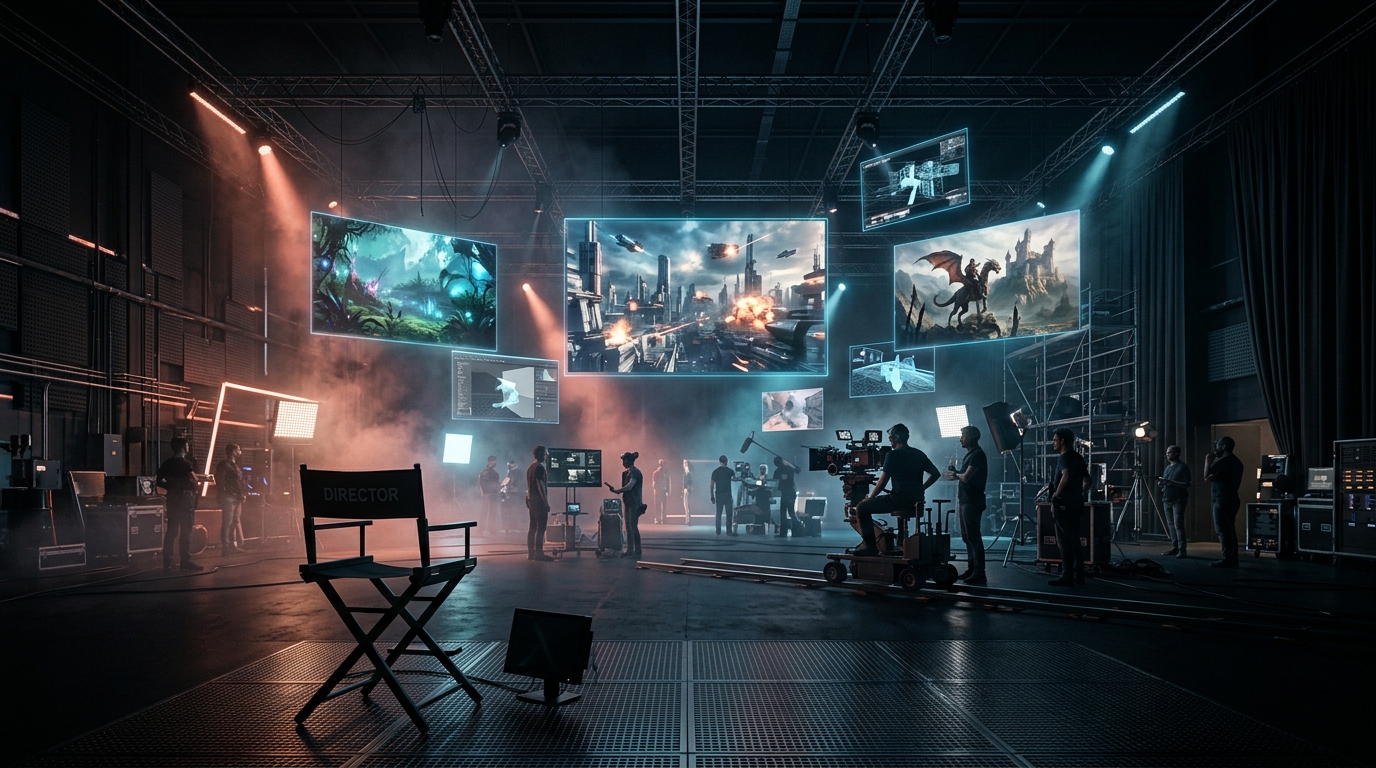
The AI filmmaking studio of 2026 — where imagination meets instant production
The State of AI Filmmaking in 2026
Three years ago, AI video generation was a research curiosity. Two years ago, it became a consumer product. Today, it is an industry. The question is no longer whether AI can generate video - it obviously can. The question is whether AI can make films: coherent, intentional, emotionally resonant visual stories with consistent characters, narrative arcs, and artistic vision.
This analysis examines where AI filmmaking stands in March 2026 - the market, the technology, the tools, the creators, and the problems that remain unsolved.
Key takeaway: The AI video generation market is projected to grow from $550 million in 2024 to over $3 billion by 2033 at 18% CAGR, with the filmmaking-specific segment growing even faster.
Size and Growth
The AI video generation market was valued at approximately $550 million in 2024 and is projected to exceed $3 billion by 2033, representing a compound annual growth rate (CAGR) of approximately 18%. These figures encompass the full spectrum of AI video applications, from enterprise marketing automation to individual creator tools.
The filmmaking-specific segment - tools and platforms used to create narrative video content with AI - is growing faster than the overall market, driven by:
Exploding demand for video content across platforms (YouTube, TikTok, Instagram Reels)
Falling costs of AI video generation
Rising quality that approaches "good enough" for professional use
Creator economy growth that rewards prolific, consistent content production
Investment Landscape
Venture capital investment in AI video and filmmaking tools totaled over $2.1 billion in 2025, with major rounds including Runway's Series D, Pika's Series B, and significant funding for emerging players like Artiroom and several stealth-mode startups focused on character consistency and narrative structure.
Enterprise spending on AI video tools is projected to reach $800 million in 2026, as marketing departments, studios, and agencies integrate AI generation into their production workflows.
Growth chart visualization showing AI video market trajectory
AI video generation market trajectory: $550M in 2024 to $3B+ by 2033
Creator Economy Impact
An estimated 12 million creators worldwide now use AI video tools at least monthly, up from approximately 3 million in 2024. The fastest-growing segment is AI-native creators - individuals who build entire channels and content businesses around AI-generated video rather than using AI as a supplement to traditional production.
YouTube channels featuring AI-generated content have grown 340% year-over-year in subscriber counts, with several channels exceeding 1 million subscribers. The monetization question has shifted from "can you make money with AI video?" to "how much?"
Technology Trends
Key takeaway: Single-clip quality has converged among top platforms - the differentiator has moved to character consistency, story-to-video pipelines, and multi-scene coherence.
1. Character Consistency Is the New Frontier
Single-clip quality has effectively converged among the top 4-5 platforms. Runway, Sora, Kling, and several others produce visually impressive individual clips. The differentiator has moved upstream: can you make multiple clips that belong in the same story?
Character consistency - maintaining a character's visual identity across scenes - has emerged as the defining technical challenge and the primary feature demand from professional creators. Surveys of AI video users consistently rank "consistent characters" as the #1 requested improvement, ahead of resolution, duration, and motion quality.
Artiroom's Visual DNA represents the most advanced solution to this problem, analyzing 40+ visual attributes and preserving them architecturally across generations. Other approaches - LoRA fine-tuning, face embeddings, reference image conditioning - exist but produce significantly less reliable results.
The market is signaling clearly: the next winner in AI video will be the platform that solves character consistency most completely.
The industry is moving beyond prompt-to-clip toward complete narrative pipelines. Instead of generating one clip at a time with a text prompt, creators want to:
Write a script or story
Define characters with consistent identities
Generate a storyboard or shot list
Produce video scenes that maintain coherence
Assemble scenes into a finished film
This workflow mirrors traditional film production, adapted for AI generation. Tools that support this pipeline - from script input to final export - are gaining adoption over tools that only handle the generation step.
Artiroom offers the most complete pipeline currently available: script → character definition (Visual DNA) → storyboard → scene generation → timeline assembly → export. LTX Studio offers a storyboard-centric approach. Most other platforms remain clip-centric.
Clip duration has extended from 4 seconds (the standard in 2024) to 10-20 seconds in 2026, with some platforms experimenting with 30-second and 60-second generations. Resolution has moved from 720p standard to 1080p standard with 4K available on premium tiers.
These technical improvements matter for filmmaking because:
Longer clips mean fewer cuts and more natural scene pacing
Higher resolution enables large-screen viewing and film festival submission
Both improvements reduce the post-production effort required to assemble a finished film
4. Audio Integration
AI video tools are beginning to integrate audio generation:
Music - AI-generated soundtracks that match the mood of generated video
Sound effects - Ambient audio, foley sounds, and environmental audio
Voice - Character dialogue and narration using AI voice synthesis
Currently, audio integration is early-stage. Most creators use standalone audio tools (ElevenLabs, Suno, Udio) and compose audio in a separate editing step. Expect tighter integration throughout 2026 and 2027.
5. Real-Time and Interactive Generation
The latency of AI video generation has dropped from minutes per clip to under 30 seconds for standard quality on leading platforms. This enables more iterative, exploratory creative workflows where creators can rapidly test ideas and converge on the right visual direction.
The next milestone - true real-time generation at interactive framerates - remains 2-3 years away for high-quality output, but low-resolution previews are already approaching real-time speeds.
The evolution of AI filmmaking from novelty clips to character-consistent narratives
The Tool Landscape
Key takeaway: The market has stratified into three tiers - major platforms (Runway, Sora, Kling, Artiroom), established players (Pika, Luma, LTX Studio), and emerging specialists - with open-source trailing 6-12 months behind.
Tier 1: Major Platforms
Runway - The pioneer. Largest community, most mature ecosystem, extensive editing tools. Weakest on character consistency.
Sora (OpenAI) - Highest single-clip realism. Part of the ChatGPT ecosystem. No multi-scene or consistency features.
Kling (Kuaishou) - Best value. Strong quality at low prices. Basic face consistency via Face Lock.
Artiroom - Purpose-built for filmmaking. Visual DNA character consistency. Full story-to-video pipeline.
Tier 2: Established Players
Pika - Fast, accessible, social-media focused. No persistent character-identity mechanism.
Luma Dream Machine - Strong cinematic quality per clip. No consistency or storytelling features.
LTX Studio - Storyboard-first approach. Good planning tools, average generation quality.
Tier 3: Emerging and Specialized
Story2Vid - Automated script-to-video. Interesting concept, early execution.
Haiper - Motion-focused with emerging style consistency features.
Viggle - Character animation specialist for rigging and motion.
Multiple stealth startups focused on specific verticals (education, marketing, gaming cinematics).
The open-source AI video community continues to advance:
Wan (Alibaba) and HunyuanVideo (Tencent) provide high-quality open-weight models
ComfyUI workflows enable customizable pipelines for technical users
AnimateDiff and its successors enable animation from image models
Community-developed LoRAs and IP-Adapter configurations provide partial consistency solutions
Open-source tools remain 6-12 months behind commercial platforms in quality and significantly behind in usability, but they serve as important proving grounds for new techniques.
The AI video tool landscape in 2026: three tiers of market players
Unsolved Problems
Key takeaway: Despite remarkable progress, long-form coherence, precise action control, multi-character interaction, physics edge cases, emotional subtlety, and IP law remain fundamentally unsolved.
Despite remarkable progress, several fundamental challenges remain:
1. Long-Form Coherence
Generating a visually coherent 10-minute video is still far beyond current capabilities. Films are assembled from individual clips, each 5-20 seconds long. Maintaining consistency across 30-60 clips requires tools like Visual DNA that enforce identity at the system level.
2. Precise Action Control
Current models excel at broad scene descriptions but struggle with precise action direction: "character picks up the cup with their left hand" or "character takes exactly three steps forward." Fine-grained action control remains an active research area.
3. Multi-Character Interaction
Scenes with two or more characters interacting - having a conversation, shaking hands, fighting - are significantly harder to generate than single-character scenes. Spatial relationships, eye lines, and physical interaction between characters remain unreliable.
4. Physics and Continuity
While physics simulation has improved dramatically, edge cases remain: liquids, cloth dynamics, reflections in mirrors, and small object manipulation still produce frequent artifacts. Scene-to-scene continuity of environment details (objects on a table, weather conditions, time of day) is not yet systematically tracked.
5. Emotional Subtlety
Generating a character who looks "slightly worried but trying to hide it" is far harder than generating a character who is "happy" or "sad." Emotional nuance in facial expression and body language is an area where AI video lags significantly behind human performance.
6. Intellectual Property and Rights
The legal framework for AI-generated content remains unsettled. Questions about training data rights, output ownership, and commercial use are being adjudicated in courts globally. Creators and platforms navigate a landscape of legal uncertainty.
Where the Industry Is Heading
Key takeaway: Character consistency will become table stakes by 2027, full-length AI narrative generation will be feasible by 2029, and the long-term trajectory points toward real-time cinematic generation and democratized filmmaking.
Short-Term (2026-2027)
Character consistency becomes table stakes - Every major platform will ship some form of identity preservation. Quality will vary dramatically.
Audio-visual integration tightens - Expect combined video + audio generation from single prompts.
Enterprise adoption accelerates - Marketing departments and agencies will systematize AI video production.
Film festival acceptance grows - Dedicated AI film categories at established festivals. Several AI-native festivals gain prominence.
Full-length narrative generation - Producing a 15-30 minute coherent narrative from a script becomes feasible for skilled creators.
Interactive and branching narratives - AI-generated video enables choose-your-own-adventure style content at scale.
Personalized content - Video content that adapts to viewer preferences, featuring consistent characters in personalized scenarios.
Industry-specific verticals - Specialized tools for education, real estate, e-commerce product video, and medical training.
Long-Term (2029+)
Real-time cinematic generation - Live generation of high-quality video at interactive frame rates enables new media formats.
AI-human hybrid production - Traditional filmmakers use AI for pre-visualization, stunt doubles, set extension, and alternative takes as a standard part of the production pipeline.
Democratized filmmaking - The cost and skill barrier to producing professional-quality video approaches zero, enabling billions of people to become filmmakers.
Artiroom's Position
Key takeaway: By solving character consistency first - the industry's highest-priority problem - Artiroom has built a structural advantage that becomes more valuable as the market shifts from clip generation to narrative production.
Artiroom occupies a strategic position in this landscape. By solving character consistency first - the problem the industry has identified as the highest priority - the platform has built a foundation that becomes more valuable as the market matures.
As the industry moves from clip generation to narrative production, the platforms that can maintain character identity, visual style coherence, and story structure across many scenes will capture the filmmaking market. Artiroom's Visual DNA and story-to-video pipeline are built for exactly this transition.
The company's focus on the creator market - individual filmmakers, small studios, and content creators - aligns with the fastest-growing segment of AI video adoption. Enterprise applications will follow, but the creative community is where innovation happens fastest.
Summary: AI filmmaking in 2026 has crossed from impressive demo to usable production tool, with a market projected to exceed $3 billion by 2033 and 12 million monthly creators - but character consistency remains the defining challenge, and tools like Artiroom that solve it architecturally will shape the next era of the medium.
Conclusion
AI filmmaking in 2026 is at an inflection point. The technology has crossed from "impressive demo" to "usable production tool," but significant gaps remain between what creators want and what tools deliver. Character consistency, narrative structure, and multi-scene coherence are the frontiers.
The next two years will determine which platforms become the standard tools of AI filmmaking - just as Premiere and After Effects became the standards of traditional post-production. The winners will be the tools that understand filmmaking is not about generating clips. It's about telling stories with consistent characters in coherent worlds. That's the bar, and the tools that meet it will shape the future of the medium.